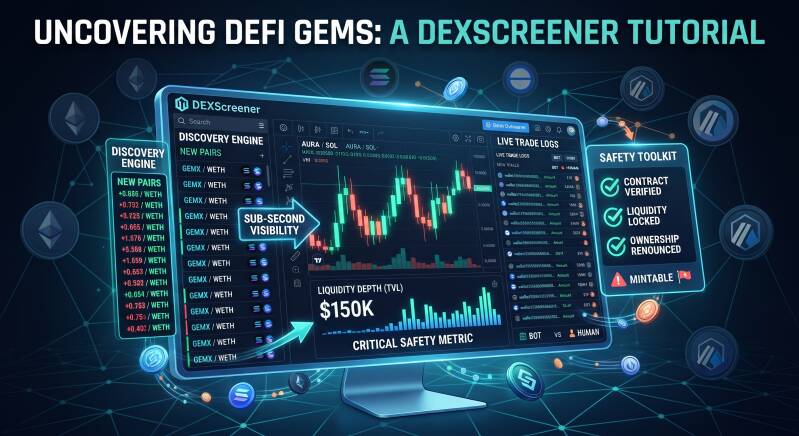
For decentralized finance traders, waiting for centralized exchange listings often means missing early liquidity phases. DEXScreener offers sub-second visibility into raw liquidity pools, DEX trade execution streams, and new trading pairs across 60+ blockchains. This guide explains how to read live DEX pair charts, evaluate contract metrics, and monitor micro-cap token flows safely.
The Need for Speed in Decentralized Finance
In the world of centralized exchanges (CEXs), tokens undergo rigorous vetting before listing. In decentralized finance (DeFi), anyone can create a market for a new token instantly by adding initial liquidity to a decentralized exchange (DEX) like Uniswap (Ethereum), Raydium (Solana), or PancakeSwap (BNB Chain).
This permissionless system creates massive opportunity but also significant risk. The time between a token launch and its initial price discovery is often compressed into minutes. To participate in these early stages, traders need tools that aggregate real-time blockchain data faster than standard block explorers. DEXScreener has become the industry standard for this specific task.
Core Features of DEXScreener
DEXScreener functions as a live market data aggregator for the entire on-chain ecosystem.
-
Real-Time Charts: Unlike CEX charts which may update every few seconds, DEXScreener charts update directly via WebSockets connected to blockchain nodes, showing price action almost instantly as trades occur on-chain.
-
Live Trade Feed: A visible order book for the DEX pair, showing every buy and sell transaction, the wallet address involved, the amount, and the dollar value.
-
New Pairs Scanner: A continuously updating list of every newly created liquidity pool across all supported chains. This is the primary tool for finding early-stage projects.
-
Token Security Info: Integrated tools that check if a contract is renounced, if liquidity is locked, and identify potential "honeypot" mechanisms (where you can buy but not sell).
Step-by-Step Tutorial: Finding and Vetting New Pairs
The following workflow is commonly used by on-chain traders to identify and analyze new tokens quickly.
1. Monitoring the "New Pairs" Feed
This is high-risk, high-reward territory.
-
Navigate: Go to dexscreener.com.
-
Filter Chains: By default, it shows all chains. Use the filter dropdown on the left to select specific high-activity chains like Solana, Ethereum, or Base.
-
Sort: Click on the "Created" column header to sort by newest first. You will see pairs created mere seconds ago.
2. Reading Live DEX Pair Charts
Once you click on a new pair, you need to interpret the chart rapidly.
-
Liquidity Depth (TVL): Look below the chart for Total Value Locked (TVL). A new pair with only $500 of liquidity is untradeable; any significant buy will cause massive slippage (buying your own token at a much higher price than intended). Seek pairs with at least $20-50k in initial liquidity for micro-caps.
-
Volume vs. Market Cap: A new token with $1M volume in the first 15 minutes indicates high interest. Compare this volume to the current market capitalization to gauge the velocity of money moving through the asset.
-
The Candle Spread: In the first few minutes, candles will be erratic. Look for sustained buy pressure rather than a single large "wallet" (developer) providing initial liquidity and then immediately dumping.
3. Vetting the Smart Contract (Crucial Safety Step)
Before interacting with any new token, you must perform basic due diligence using DEXScreener's integrated data.
-
Scroll to the Pair Info Section: Below the chart, look for contract indicators.
-
Check "Top Traders" / "Holders": Click this tab. If the top 10 wallets hold 90% of the supply, the token is highly centralized and susceptible to manipulation or a "rug pull" (where the team removes liquidity).
-
Look for Warnings: DEXScreener often flags common exploits, such as "Mintable" (the developer can create more supply out of thin air) or "Cannot Sell" (honeypot risk).
Interpreting Micro-Cap Token Flows
Understanding the data stream on the right side of the screen is vital.
-
"Bots" vs. Humans: In the live trade logs, rapid-fire buys of identical small amounts (e.g., 0.1 SOL) immediately after launch usually indicate automated trading bots. While risky, this often drives early price discovery.
-
"Whale" Activity: Identify large buys early on. If these wallets immediately begin selling off small portions, it indicates early profit-taking. If they hold firm, it signals confidence.
-
Liquidity Removal Alerts: DEXScreener will display a red alert if the initial liquidity is removed from the pool by the deployer. This is the definition of a rug pull; if you see this, the token value goes to zero instantly.
Conclusion: Balancing Opportunity and Risk
DEXScreener is an incredibly powerful microscope for viewing the raw, chaotic frontier of decentralized finance. It provides the fastest route to identifying new market entrants across dozens of blockchains.
However, speed necessitates caution. Because these markets are permissionless and often unregulated, the majority of new tokens listed on the "New Pairs" feed lose 90-100% of their value within days.
Use DEXScreener to find opportunities, but rely on your own strict vetting process to evaluate liquidity, contract safety, and token distribution before committing capital.
Add comment
Comments