Why Aggregate Market Benchmarks Matter in Crypto
Unlike traditional stock markets with centralized closing bells and regulated reporting standards, cryptocurrency trades continuously across a fragmented landscape of hundreds of independent global exchanges. This fragmentation can lead to price discrepancies, inflated trading volumes, and distorted liquidity metrics.
Using a standardized benchmark aggregator is essential for seeing past individual exchange anomalies. By consolidating global data streams, platforms like CoinMarketCap provide a single source of truth for live crypto prices, total market capitalizations, and macroeconomic sentiment indicators.
Core Features of CoinMarketCap
CoinMarketCap offers a comprehensive suite of tools built to track global liquidity, asset rankings, and market sentiment:
-
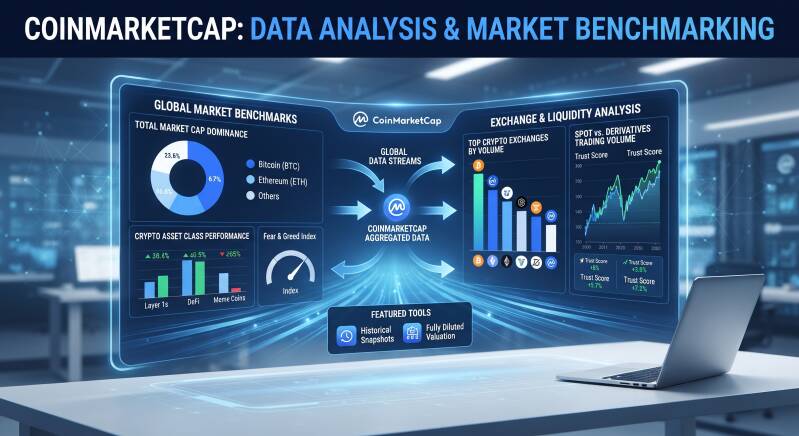
Global Market Capitalization & Dominance: Tracks the total valuation of the entire crypto asset class alongside Bitcoin and Ethereum dominance percentages.
-
Verified Exchange Volume Rankings: Evaluates centralized and decentralized exchanges based on real volume, web traffic, and liquidity scores to flag wash-trading.
-
Live Crypto Prices & Historical Data: Delivers real-time spot pricing, 24-hour volume metrics, circulating supply figures, and historical price snapshots.
-
Sector & Category Indexing: Groups tokens into thematic baskets (e.g., Layer 1s, DeFi, Meme Coins, AI) to track relative performance across narratives.
-
Crypto Fear & Greed Index & Tools: Integrates sentiment indicators, token unlock calendars, and educational crypto-learning resources.
Step-by-Step: Evaluating Market Health and Liquidity
Navigating CoinMarketCap effectively goes beyond checking whether prices are green or red on a given day. Here is how to use its core analytics for deeper research:
-
Analyze Total Market Cap & BTC Dominance: Before sizing positions, check the macro trend. If total market cap is rising while Bitcoin dominance increases, altcoins may underperform relative to Bitcoin.
-
Scrutinize Exchange Volumes: When evaluating a token, do not just look at its price. Check the exchange breakdown to ensure trading volume is concentrated on tier-one exchanges with verified liquidity rather than obscure platforms.
-
Check Circulating vs. Fully Diluted Valuation (FDV): Compare a token's market cap (circulating supply $\times$ price) to its FDV (max supply $\times$ price). A massive gap indicates heavy future token unlock pressure.
-
Use Historical Snapshots: Utilize historical data tools to analyze how top assets performed during previous macro cycles or market corrections.
CoinMarketCap vs. Independent Data Aggregators
Feature CoinMarketCap Decentralized DEX Trackers Primary Focus Macro market benchmarks, global exchange volumes, and top-tier token listings Real-time on-chain liquidity pools and micro-cap token pairs Data Aggregation Broad blend of centralized and decentralized exchange feeds Direct blockchain smart contract indexing Best Used For Macro market trend analysis, exchange vetting, and historical benchmarking Discovering early-stage decentralized tokens and tracking LP pools
Conclusion: Building a Data-Driven Workflow
Whether you are tracking live crypto prices, examining aggregate exchange volume, or using market cap benchmarks to measure cycle tops and bottoms, CoinMarketCap remains a foundational tool for crypto research.
By combining macro-level metrics with thorough tokenomics evaluations, investors can cut through market noise and make more informed, data-driven decisions.
Add comment
Comments