Why Independent Market Data Aggregation Matters
With thousands of tokens trading across centralized exchanges and decentralized networks, navigating the digital asset space requires a reliable, centralized source of truth. Without independent aggregators, traders risk relying on isolated exchange data, manipulated volumes, or incomplete circulating supply stats.
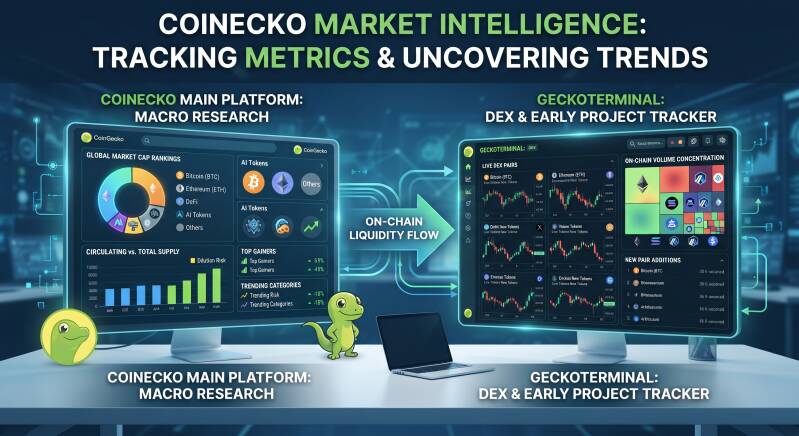
CoinGecko acts as a neutral market researcher, compiling volume-weighted pricing, trust scores, and foundational data metrics to give a transparent picture of overall market health.
Core Features and Research Tools on CoinGecko
CoinGecko provides a massive suite of features designed for market analysis, token research, and portfolio tracking:
-
Comprehensive Market Cap Rankings: Sorts assets by market capitalization, trading volume, and liquidity to establish baseline valuations.
-
Tokenomics & Supply Transparency: Details token allocation structures, emission schedules, and fully diluted valuations (FDV).
-
Sector & Category Performance: Groups tokens into sectors (such as Artificial Intelligence, Real World Assets, and Layer 2s) to track thematic capital flows.
-
GeckoTerminal Integration: Links directly to CoinGecko's native decentralized exchange (DEX) tracker to evaluate on-chain liquidity pools.
-
Portfolio & Watchlist Tools: Allows users to track custom token baskets and monitor wallet performance in real time.
Step-by-Step: Analyzing Tokenomics and Finding Trends
Using CoinGecko effectively goes beyond looking at green or red daily percentage changes.
-
Evaluate Circulating vs. Total Supply: Navigate to any token page and check the circulating supply relative to the Total and Maximum supply. A low circulating supply with heavy future unlocks can create severe dilution pressure.
-
Review the Trust Score: Check the exchange liquidity breakdown to ensure trading volume is concentrated on reputable exchanges with high Trust Scores rather than wash-trading venues.
-
Monitor Category Trends: Use the Categories tab to see which narratives (e.g., modular blockchains, gaming, AI infrastructure) are attracting net inflows versus capital outflows.
-
Transition to GeckoTerminal for Early-Stage Assets: When researching tokens not yet listed on major centralized exchanges, use GeckoTerminal to inspect raw on-chain trading pairs, pool liquidity depth, and smart contract activity.
CoinGecko vs. GeckoTerminal: Centralized vs. On-Chain Tracking
Feature CoinGecko (Main Platform) GeckoTerminal (DEX Screener)Primary Focus Aggregated market data across centralized and decentralized exchanges Real-time on-chain pricing and DEX liquidity pairs Data Source Volume-weighted averages from 1,000+ exchanges Direct smart contract logs across 100+ blockchains Best Used For Macro market research, historical charts, and tokenomics evaluation Discovering newly minted tokens and tracking DEX liquidity
Conclusion: Mastering Market Intelligence
Navigating the crypto market successfully requires separating signal from noise. By leveraging CoinGecko for macro token metrics and circulating supply insights, alongside GeckoTerminal for deep on-chain DEX tracking, investors can build a robust, data-driven research workflow.
Whether you are auditing tokenomics before an investment or setting up a custom watchlist to track market sectors, CoinGecko remains an indispensable cornerstone of any crypto toolset.
Add comment
Comments