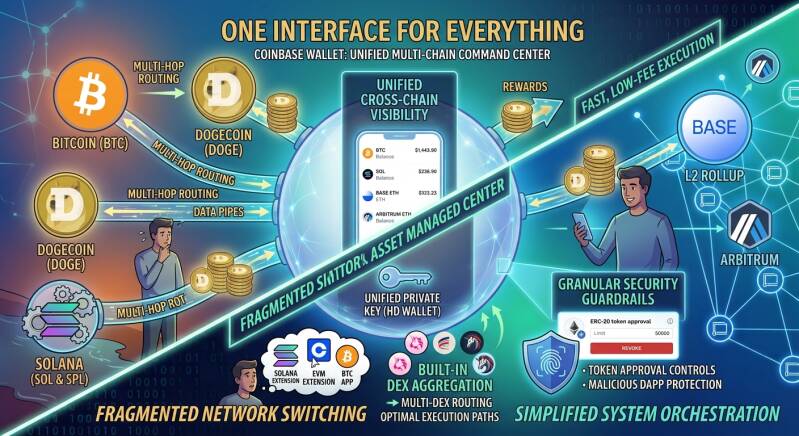
As the Web3 ecosystem expands, assets and applications are increasingly spread across multiple networks. You might hold native Bitcoin as a store of value, trade liquidity on Solana, deploy Layer-1 smart contracts on Ethereum, and execute rapid micro-payouts on Layer-2 rollups like Base or Arbitrum.
Managing this fragmented multiverse traditionally meant juggling multiple browser extensions, maintaining separate seed phrases for non-EVM ecosystems, and dealing with conflicting network settings.
Coinbase Wallet solves this multi-chain fragmentation by providing a unified orchestration layer—bringing EVM chains, Solana, Bitcoin, and UTXO networks together under one non-custodial interface.
1. The Core Argument: Navigating Fragmentation Without Friction
Fragmented tools lead to user error. Switching between a browser extension tailored exclusively for Solana, another built for EVM rollups, and a separate app for Bitcoin increases operational complexity. Every added extension expands your attack surface, exposing you to malicious updates, clipboard hijacking, and phishing traps.
True multi-chain security requires a single, hardened client capable of signing transactions across diverse consensus architectures without compromising key safety or user experience.
2. Technical Highlights
Unified Cross-Chain Asset Visibility
Coinbase Wallet abstracts away underlying chain architecture, allowing you to view and manage diverse cryptographic standards within a consolidated dashboard:
-
Multi-EVM Support: Seamlessly switch between Ethereum, Base, Optimism, Arbitrum, Polygon, and Avalanche without manual RPC configurations.
-
Heterogeneous Chain Integration: Manage native Bitcoin (BTC), Solana (SPL tokens), and Dogecoin (DOGE) alongside EVM assets within the same application interface.
-
Deterministic Key Derivation: Uses standard HD wallet paths (BIP-32/44) so a single unified backup phrase or account setup secures your cross-chain addresses safely.
Built-in DEX Aggregation & Optimal Routing
Moving tokens directly within a non-custodial wallet shouldn't require searching for individual decentralized exchanges (DEXs).
-
Multi-DEX Routing: Coinbase Wallet integrates built-in DEX aggregation, scanning liquidity pools across protocols (like Uniswap, Aerodrome, and 1inch) to calculate optimal transaction routes.
-
Slippage Protection & Gas Efficiency: By evaluating execution paths in real-time, the interface minimizes price impact and gas overhead for on-chain swaps.
Granular Token Approvals & Security Guardrails
Smart contract exploits often trick users into granting unlimited token allowances (approve infinity).
-
Transaction Previews: Before confirming a transaction, the wallet provides clear simulation breakdowns showing exact token balance changes.
-
Allowance Visibility & Revocation: Built-in allowance controls allow you to inspect open ERC-20 spending approvals and revoke unneeded smart contract permissions with a single click, reducing exposure to protocol exploits.
-
Malicious DApp & Spam Protection: Real-time blocklists and automated token filtering hide phishing airdrops and warn you prior to interacting with suspicious domain names.
The Bottom Line
A powerful Web3 setup should adapt to the multi-chain ecosystem, not force you to manually bridge assets and switch extensions just to execute a basic trade.
By combining unified cross-chain asset management, smart DEX aggregation, and strict allowance guardrails, Coinbase Wallet delivers a frictionless command center. It allows you to operate across Layer-1s and Layer-2s securely—keeping you focused on building, trading, and earning.
Add comment
Comments