A blockchain network can boast state-of-the-art cryptography and theoretical throughput, but infrastructure is ultimately only as strong as its liquidity and active ecosystem. High performance without real capital or active users results in a ghost town.
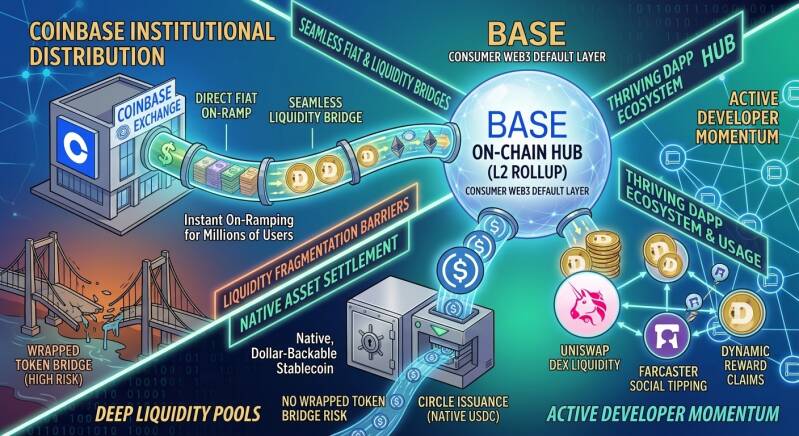
This network effect explains why Base has surged to become the default Layer-2 (L2) platform for real-world Web3 adoption. By merging institutional distribution channels with deep liquidity pools and developer momentum, Base solves the cold-start problem that stalls most emergent L2 chains.
1. The On-Chain Hub: Why Ecosystem Depth Trumps Raw Metrics
For consumer-facing applications—whether reward faucets, micro-payment gateways, or decentralized social media—users require immediate access to liquidity. They need to swap payouts, bridge assets, and utilize their tokens without encountering prohibitive slippage or complex, multi-hop routing protocols.
Base acts as a high-velocity monetary highway. Rather than fragmenting liquidity across isolated app-chains, it aggregates capital, applications, and everyday users into a unified, high-throughput execution environment.
2. Technical & Strategic Highlights
Institutional Distribution & Seamless Fiat Bridges
Base is incubated by Coinbase, granting the network direct interoperability with one of the world's largest exchange platforms.
-
Direct Exchange Ramps: Millions of verified users can move capital directly from their exchange accounts onto Base without interacting with complex third-party bridges.
-
Instant On-Ramping: Fiat-to-L2 pipelines allow users to acquire, transfer, and interact with on-chain assets in seconds, removing traditional bridge delay vulnerabilities.
Native USDC Settlement & Zero Bridge Risk
Cross-chain bridges have historically represented one of the largest attack vectors in decentralized finance. Base eliminates this systemic risk through native stablecoin integration.
-
Native Circle Issuance: Circle issues native USDC directly on Base. This is fully backed, dollar-redeemable stablecoin liquidity—not a synthetic wrapped bridge asset (USDbC).
-
Institutional Settlement: Native USDC guarantees instant, final settlement for micro-payouts, reward distributions, and merchant payments without bridge de-pegging risks or liquidity fragmentation.
A Thriving Consumer DApp Ecosystem
Developer activity creates user utility, and Base has attracted leading decentralized protocols alongside novel social platforms:
-
Liquidity Foundations: Industry-standard protocol deployments (such as Uniswap and Aerodrome) provide massive liquidity depth for low-slippage token swaps.
-
Social & Agentic Finance Protocols: Integrations with decentralized social platforms like Farcaster and emerging AI-agent transaction frameworks allow users to tip, trade, and build reputations directly on-chain.
The Bottom Line
A Layer-2 ecosystem requires more than just fast block times—it requires trusted capital, seamless user access, and active application protocols.
By combining institutional distribution, native Circle USDC settlement, and a thriving developer community, Base provides a practical, scalable foundation for daily Web3 operations. It transforms decentralized applications from niche experiments into high-volume, global platforms.
Add comment
Comments