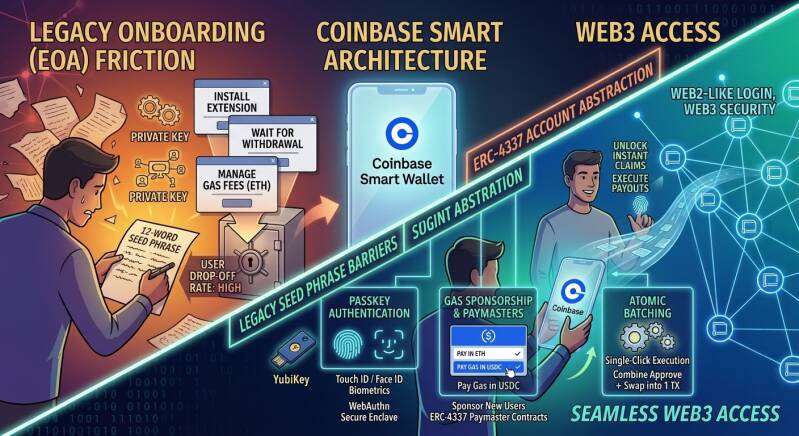
For years, onboarding a mainstream user into Web3 followed a painfully high-friction ritual: download a browser extension, write down a 12-word recovery seed phrase on paper, store it in a physical safe, buy native gas tokens on a centralized exchange, wait for withdrawals to clear, and approve multiple cryptographic popups just to execute a single token swap.
This multi-step friction was responsible for massive drop-off rates across Web3 applications.
Account Abstraction (ERC-4337) completely rewrites this onboarding paradigm. By replacing legacy Externally Owned Accounts (EOAs) with programmable smart contract accounts, tools like Coinbase Smart Wallet give users a seamless, Web2-like login while preserving non-custodial Web3 security guarantees.
1. The Core Architecture: EOAs vs. Smart Accounts
In traditional Ethereum accounts (EOAs), the account and the signing key are permanently bound together. If you lose the private key or seed phrase, you lose access to the account forever.
Account Abstraction decouples the signing key from the account logic. Your wallet becomes an executable smart contract deployed on-chain. Because the verification rules are written in code rather than hardcoded into the protocol, developers can define custom authentication, social recovery, session permissions, and automated fee handling.
2. Key Technical Breakthroughs
Passkey Authentication (WebAuthn)
Instead of forcing users to manage 12-word seed phrases, Coinbase Smart Wallet leverages native device biometrics via Passkeys (WebAuthn).
-
Biometric Sign-In: Users create and sign into their wallet using Touch ID, Face ID, or hardware security keys (like YubiKeys) directly in their browser.
-
Hardware Enclave Encryption: Keys are generated and stored securely inside the mobile device or desktop hardware security enclave, preventing phishing attacks and eliminating paper seed phrase vulnerabilities.
Gas Sponsorship & Paymasters
One of the largest barriers for new Web3 users is needing native tokens (like ETH) just to pay gas fees before interacting with an application.
-
ERC-4337 Paymasters: Paymasters are helper smart contracts that validate and pay transaction gas fees on behalf of the user.
-
Sponsored Onboarding: Applications can sponsor gas fees entirely for new users during promotional onboarding, or allow users to pay gas using stablecoins like USDC rather than holding native gas tokens.
Atomic Batching
With traditional accounts, executing a basic decentralized exchange swap requires two separate network calls: an initial Approve transaction followed by the Swap transaction.
-
Single-Click Execution: Smart wallets support atomic batching, combining token approvals, contract calls, and execution transfers into a single UserOperation. Users sign once, reducing gas usage and eliminating repeated popup prompts.
The Bottom Line
Seed phrases were a necessary bridge during Web3's early development, but widespread adoption requires an interface that feels as intuitive as Face ID or Google Sign-In.
Through ERC-4337, passkeys, paymaster sponsorship, and atomic batching, Coinbase Smart Wallet removes the technical friction that previously held back mainstream users—delivering a Web2 user experience backed by Web3 security and self-custodial control.
Add comment
Comments