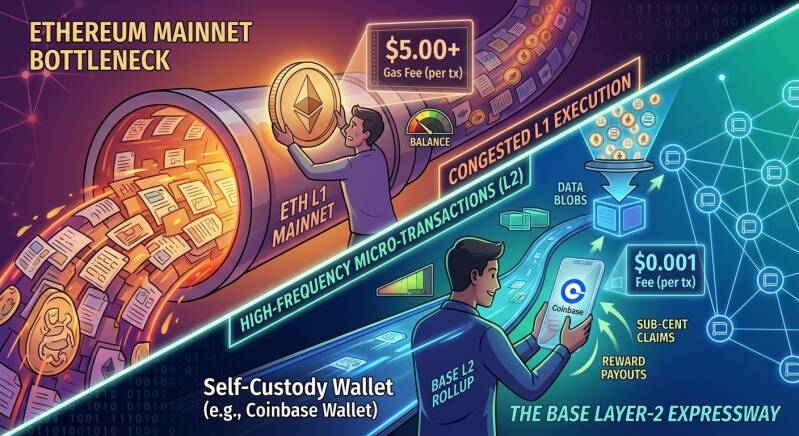
Ethereum remains the gold standard for decentralized security, developer activity, and smart contract innovation. However, Layer-1 (L1) Ethereum Mainnet was never designed to process high-frequency, low-value micro-transactions directly on-chain.
For platforms reliant on small, frequent payouts, dynamic reward claims, micro-tipping, or high-volume Web3 tasks, mainnet execution costs create an immediate economic bottleneck.
Enter Base—an Ethereum Layer-2 (L2) network built to scale Web3 throughput by drastically lowering transaction costs without sacrificing Ethereum's underlying security guarantees.
1. The Core Problem: The Micro-Transaction Bottleneck
Executing micro-payouts on Layer 1 is mathematically inefficient. Paying even a modest fee to move a $0.05 or $0.10 reward makes small-value transactions unviable for both operators and users.
To make everyday Web3 applications, gaming platforms, and reward faucets practical at scale, execution must happen off-chain while anchoring final settlement back to Ethereum's decentralized consensus layer. Base delivers this exact architecture, bringing per-transaction costs down to fractions of a cent.
2. Technical Highlights
Optimistic Rollups & EIP-4844 Data Blobs
Base functions as an Optimistic Rollup. Instead of executing every individual interaction directly on Ethereum Mainnet, Base processes thousands of transactions in a high-speed off-chain execution layer, compresses the data into a single batch, and posts the proof to Ethereum.
-
EIP-4844 (Proto-Danksharding): Historically, L2 rollups submitted batch data using standard Ethereum CALLDATA. With EIP-4844, Base utilizes dedicated, short-term data units called blobs.
-
Sub-Cent Fees: Decoupling L2 data storage from permanent L1 smart contract memory reduced transaction submission costs by over 90–99%, enabling steady, sub-cent transaction fees.
OP Stack Infrastructure & EVM Equivalence
Base is built on the OP Stack, the open-source development architecture maintained by the Optimism Collective.
-
Full EVM Equivalence: Base is bytecode-equivalent to the Ethereum Virtual Machine (EVM). Standard Ethereum smart contracts, developer toolkits, and wallet libraries (like Ethers.js, Web3.js, and Viem) run seamlessly on Base without requiring custom rewrite code.
-
Inherited Mainnet Security: Base relies on Ethereum’s proof-of-stake validator network to verify state transitions, ensuring L2 execution speed doesn't come at the expense of network integrity or decentralization.
The Bottom Line
High transaction fees shouldn't prevent users from accessing their earnings or interacting with on-chain applications.
By leveraging Optimistic Rollups, EIP-4844 blob compression, and the open OP Stack, Base brings high-frequency, sub-cent settlement to the Web3 ecosystem. It makes micro-payouts, dynamic claims, and scalable decentralized applications seamless, cost-effective, and ready for global adoption.
Add comment
Comments